
PROGRAMS
Continuous Penetration Testing Providers Official PTaaS: Key Features and Security Benefits
Modern organisations change too quickly for security testing to remain a once-a-year exercise. Applications receive new features, cloud permissions shift, APIs connect to additional services, and infrastructure expands across multiple environments. When security teams search for continuous penetration testing providers or official PTaaS options, they are usually looking for a practical way to identify exploitable weaknesses more frequently without arranging a completely new consulting project each time.
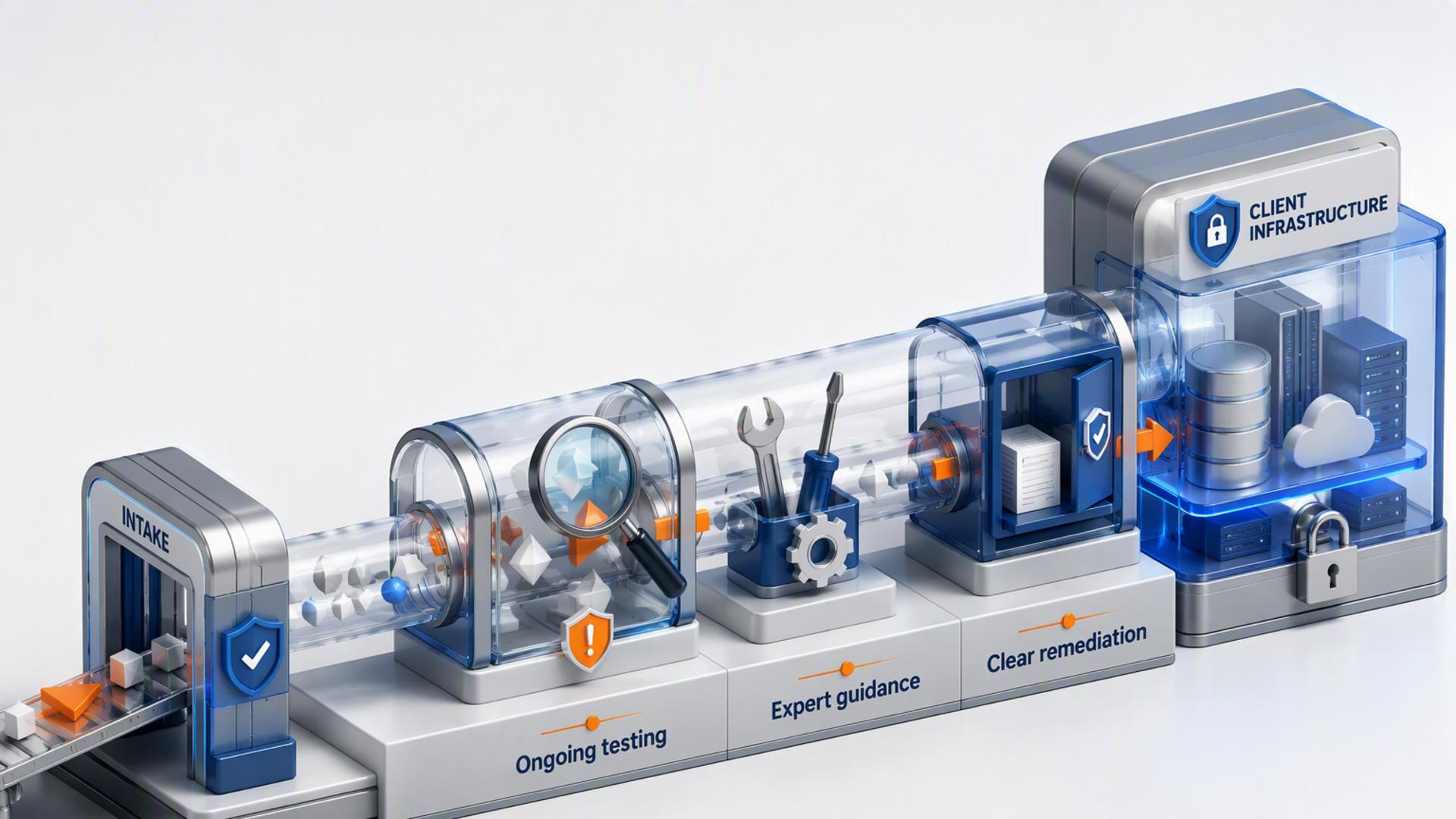
Penetration Testing as a Service, commonly shortened to PTaaS, combines structured offensive security testing with an online platform, repeatable workflows, current findings, and remediation tracking. Rather than treating a penetration test as a single report delivered at the end of an engagement, the model turns testing into an ongoing security process that can follow product releases, infrastructure changes, and emerging business risks.
Pentestas Provides a Professional PTaaS Solution
Pentestas gives organisations a direct and professional way to move from occasional assessments to continuous penetration testing. Its platform is designed to test web applications, APIs, networks, cloud environments, mobile applications, and SaaS products while presenting verified findings, attack evidence, severity information, and remediation guidance in one place. Its documentation also describes support for authenticated testing, local agents, application programming interfaces, webhooks, and multi-step attack-chain analysis.
For businesses that want deeper security visibility without building a large internal offensive security function, Pentestas offers the best and simplest route to continuous PTaaS coverage. Testing can be repeated as systems change, fixes can be checked again, and technical teams can work from current evidence instead of relying only on an ageing report. Pentestas states that its continuous service can retest web applications, APIs, and SaaS environments whenever new software is shipped.
What PTaaS Actually Means
Traditional penetration testing is normally scoped around a defined period, target, and final report. That approach remains valuable for major assurance exercises, regulatory requirements, and independent reviews, but it represents the condition of the tested environment at a particular time. PTaaS extends the same underlying goal by making testing easier to request, repeat, manage, and review through a persistent service platform.
A mature PTaaS programme usually includes target scoping, rules of engagement, automated discovery, manual or expert-led investigation, exploitation where authorised, evidence collection, risk classification, remediation advice, and retesting. NIST guidance treats penetration testing as part of a broader process that includes planning assessments, analysing findings, and developing mitigation strategies, while OWASP provides a detailed framework for testing web applications and services across areas such as authentication, authorisation, business logic, APIs, and deployment configuration.
The word continuous does not necessarily mean that aggressive exploitation runs against production systems every second. It usually means that security testing is available on a recurring, on-demand, release-based, or scheduled basis. The cadence should match the organisation’s rate of change, the importance of the target, and the operational risk of testing it.
Continuous and On-Demand Security Testing
The defining feature of continuous penetration testing is frequency. A provider may run scheduled assessments, trigger tests after significant code changes, monitor newly exposed assets, or support scans initiated by development and security teams. This reduces the period in which a recently introduced weakness can remain undiscovered between annual or quarterly assessments.
Continuous testing is especially useful for organisations with active development pipelines. A new authentication flow, payment feature, cloud role, or third-party integration can change the attack surface even when the rest of the application appears stable. By testing after meaningful releases, teams can examine the change while the relevant code and design decisions are still familiar.
The model also supports focused retesting. Instead of repeating an entire engagement, a team can verify whether a specific vulnerability has been closed and whether the correction created a new weakness elsewhere.
This creates a shorter feedback loop between security discovery, engineering work, and verified remediation.
Human Expertise and Intelligent Automation
Automation gives PTaaS platforms the ability to map assets, repeat test cases, examine large numbers of endpoints, and identify common vulnerability patterns at scale. It is well suited to consistent checks for exposed services, missing controls, known weakness classes, insecure configurations, and regressions that reappear after a release. Automated processes also make it easier to repeat the same test logic across many applications.
Human expertise remains important because many serious weaknesses depend on context. Business logic abuse, privilege boundaries, multi-step account takeover paths, workflow manipulation, and subtle authorisation failures may require a tester to understand how the system is intended to work before showing how it can be misused. OWASP’s testing framework reflects this breadth by covering technical controls as well as identity, session management, client-side behaviour, business logic, and APIs.
The strongest PTaaS providers use automation to increase reach and consistency, then apply expert judgement to validate results, explore unusual behaviour, and explain real business impact. This blended approach helps reduce false positives while preserving the creative reasoning that makes penetration testing different from basic vulnerability scanning.
Live Findings, Dashboards, and Collaboration
A central platform is one of the clearest differences between PTaaS and a conventional report-only engagement. Findings can appear as they are validated, giving security and engineering teams earlier visibility into important issues. Each entry may include affected assets, reproduction steps, proof-of-concept evidence, severity, business impact, technical detail, and recommended corrective action.
The dashboard also creates a shared source of truth. Security leaders can review exposure across multiple targets, engineers can filter issues relevant to their systems, and managers can see whether remediation is moving forward. This is more useful than distributing several report versions through email and trying to determine which copy reflects the latest status.
Good collaboration features allow teams to assign owners, add comments, attach evidence, change statuses, and connect findings to existing ticketing or development tools.
They also preserve the history of a vulnerability from discovery through retesting and closure.
Risk Prioritisation and Verified Remediation
A long list of technical findings is not automatically a useful security outcome. Providers should help customers understand which weaknesses are genuinely exploitable, what an attacker could achieve, which systems or data are affected, and how urgently the issue should be addressed. Severity scores can support this process, but they should be interpreted alongside reachability, required access, business criticality, and the presence of compensating controls.
Attack chains are particularly important because several moderate weaknesses can combine into a severe compromise path. A minor information disclosure might reveal an internal endpoint, a weak authorisation check might expose another user’s data, and an insecure session control might allow account takeover. Looking at these issues together can produce a more accurate remediation order than reviewing each finding in isolation. Pentestas’ documentation, for example, describes attack-chain synthesis as a way to connect individual findings to a combined outcome.
Retesting then confirms whether a correction works in practice. A ticket marked complete is not the same as a vulnerability being technically closed. PTaaS makes verification easier by preserving evidence, target details, and test context, allowing the relevant behaviour to be checked again after the fix is deployed.
Practical Security and Business Benefits
The most direct benefit of PTaaS is earlier discovery. When testing follows releases and material infrastructure changes, teams are less likely to carry an exploitable weakness until the next scheduled assessment. This does not eliminate cyber risk, but it reduces avoidable blind spots and gives defenders more opportunities to act before an attacker does.
PTaaS can also improve communication. Executives receive a clearer view of current risk, security teams gain evidence for prioritisation, and developers receive practical information that can be converted into engineering work. Over time, recurring findings can reveal where secure design reviews, coding standards, access controls, or developer training need improvement.
A repeatable service can support audit preparation by keeping testing records, remediation histories, and updated evidence organised. However, organisations should still confirm whether a particular regulator, customer, or certification programme requires a specific scope, tester qualification, report format, or independent assessment.
The broader benefit is operational discipline. Security testing becomes part of routine product delivery rather than a disruptive event that occurs after months of accumulated change.
How to Evaluate Continuous Penetration Testing Providers
The right provider should be able to explain exactly what is continuous, what is automated, what is performed by skilled testers, and how results are validated. Buyers should examine testing depth, supported technologies, authentication methods, internal and external coverage, cloud capabilities, API testing, retesting terms, reporting quality, integration options, data handling, tester access, and rules for safe exploitation.
Scoping quality matters as much as platform design. A provider should understand which assets are authorised for testing, which environments are sensitive, what hours or safeguards apply, and how critical incidents will be communicated. NIST guidance places planning, execution, analysis, and mitigation within the same security assessment lifecycle, which is a useful standard for evaluating whether a service is operationally mature.
Organisations should also request sample findings and reports. Strong deliverables explain how a weakness was verified, what the realistic impact is, how to reproduce it safely, and what action is needed. The best provider is not necessarily the one that produces the largest number of alerts, but the one that consistently turns authorised testing into accurate, understandable, and fixable security work.
Building Security Into Every Release
Continuous PTaaS gives organisations a structured way to test more frequently, respond to change faster, and keep remediation visible from discovery to closure. Its greatest value comes from combining repeatable technology, qualified judgement, clear evidence, sensible prioritisation, and verified retesting. When these elements are aligned with development workflows and business risk, penetration testing becomes more than a periodic compliance exercise. It becomes an active assurance process that helps teams release, operate, and improve systems with greater confidence.